Since July 2025, American universities can pay their athletes directly. But there is fine print that changes everything if you come from Spain.
If you follow the world of American college basketball, you have probably heard about NIL — Name, Image and Likeness — and the new agreement that allows universities to pay their athletes directly. It is arguably the biggest change in the history of American college sports in the last hundred years.
And if you are considering making the leap to the United States, it is essential that you understand exactly what this change means and, above all, what it does not mean for you as an international player.
What has changed: the new era of direct payments
Since July 1, 2025, American universities can pay their athletes directly. Each university can spend up to 20.5 million dollars per season, a figure that will gradually increase to exceed 30 million by the end of the ten-year agreement.
A new entity called the College Sports Commission will oversee payments, NIL deals, sponsorships and roster limits to ensure fairness and compliance with the rules.
In addition, the agreement replaces scholarship limits with roster limits of 15 players for women’s basketball, which in theory allows every player on the roster to receive a scholarship. On paper, more players than ever could access full funding.
It sounds like a revolution. And it is. But it comes with a huge catch if you come from outside the United States.
The catch nobody tells you: international players are left out
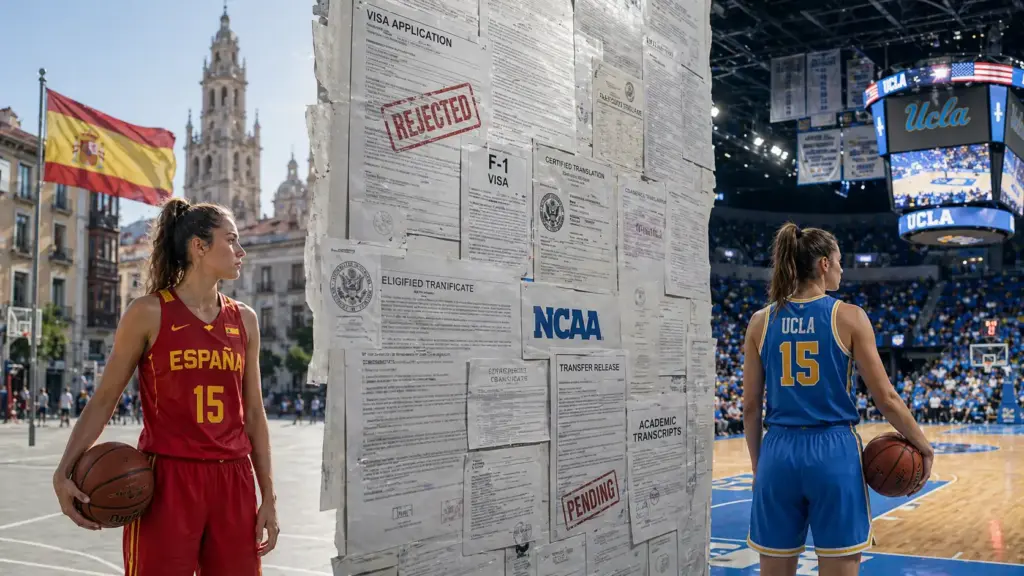
International athletes cannot benefit from these direct payments. Most hold F-1 student visas that are subject to very strict rules preventing them from receiving payments for playing sport or generating income through NIL deals. If universities were to pay their international athletes, they could violate federal immigration laws and face serious consequences.
Put it in real terms: while your American teammate may be earning a salary from the university or closing advertising contracts through NIL, you — with the same performance, the same effort and the same value to the team — cannot receive that money without risking your immigration status and your scholarship.
It is still unclear how universities will manage these new rules or how they will guarantee fairness between domestic and international players. Changes may come in the future, but nobody knows yet in which direction or when.
So, is the leap to the United States still worth it?
Yes. Absolutely yes. But with clear information about what awaits you.
The traditional athletic scholarship — the one that covers tuition, housing, meals and materials — remains fully accessible to international players and is still one of the greatest opportunities the American university system can offer you. A full scholarship can be worth between 40,000 and 80,000 dollars per year. That has not changed.
What has changed is the competitive context within each team. With American teammates earning real salaries, the internal dynamics of locker rooms will shift. You need to arrive with the right profile, at the right program and with the right information.
How to navigate this new environment as a Spanish player
At Sport Change Project we have analysed in detail how these changes affect you and have adapted our strategy accordingly. These are our recommendations.
Junior College remains your best entry point. Two-year programs have more flexible structures, more welcoming environments for international players and allow you to adapt to the American rhythm — on and off the court — before making the jump to Division I or Division II.
Documentation is everything. Any scholarship agreement or academic commitment must be clearly written in official documents. Verbal promises from a coach, no matter how prestigious, have no legal value. Never sign anything without fully understanding it or without proper guidance.
English is no longer optional. In an increasingly professional and competitive environment, arriving with a solid level of English gives you a real advantage not only on the court but in negotiations, in class and in daily life.
The American university system remains the greatest opportunity available to you as a Spanish basketball player. But entering without the right information is more dangerous than ever. That is exactly why we are here.