
In an era where money dominates American college basketball, the Bruins won by betting on something completely different. Here’s what every player should learn from their story.
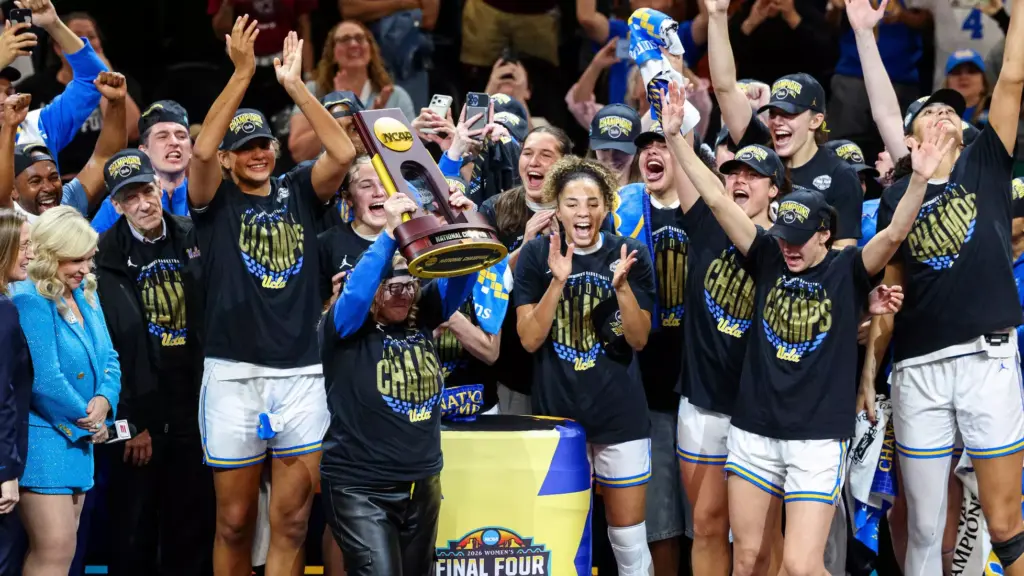
On April 5, 2026, the UCLA Bruins were crowned champions of the NCAA women’s tournament after dominating South Carolina Gamecocks 79-51 in the final held in Phoenix. Gabriela Jaquez was the standout player of the game with 21 points and 10 rebounds.
But beyond the scoreboard, this title carries a story that speaks directly to what we believe in at Sport Change Project. A story about patience, development, and process. Exactly the values we have built our program around.
The context: money has changed the game
In recent years, American college basketball has undergone an unprecedented revolution. The arrival of NIL — Name, Image and Likeness — and the expansion of the Transfer Portal have created a market where the wealthiest programs can literally buy championship-contending rosters over a single summer.
On the men’s side, there are documented cases of universities paying up to three million dollars for a single transfer player. The athletic budget of a university like Michigan exceeds 150 million dollars per year. The market has professionalized at a staggering speed, and the gap between programs with resources and those without has never been wider.
In this context, what UCLA has achieved carries even greater significance.
Fifteen seasons building something real
Cori Close has been at the helm of the UCLA women’s basketball program for 15 seasons. Her philosophy, deeply influenced by the legendary coach John Wooden, is rooted in character, human development, and the construction of a collective identity.
While other universities were chasing the portal and spending millions on transfers, Close built a group of players who grew together over years. The championship team was led by six seniors who closed the season with a 37-1 record and a 31-game winning streak. This is not a team assembled over one summer. This is a project built over years of daily work, sacrifice, and shared purpose.
Lauren Betts, one of the team’s key pieces, finished the championship game with 16 points and 11 rebounds and was named the Final Four Most Outstanding Player. FIBA Betts arrived at UCLA as a promising young player and left as a champion and the first overall pick in the WNBA draft. That kind of growth does not happen overnight. It is built training by training, season by season.
Gabriela Jaquez herself, after lifting the trophy, said: “I imagined this moment so many times. I am so, so proud.” That is what a process built over years feels like when it finally comes together.
The model that won: development over transactions
What makes UCLA’s story particularly powerful is the contrast with how many programs operate today. In an environment where rosters are rebuilt every summer through the portal, where players jump from program to program chasing better offers, UCLA stayed true to a different philosophy.
Their approach mirrors what we see in the best women’s programs globally: focus on identity, invest in relationships, develop the whole athlete — not just the player. Close has spoken openly about how Wooden’s “Pyramid of Success” shaped her coaching philosophy, emphasizing that doing things the right way, consistently, is what produces lasting results. Global College USA
The numbers back it up. UCLA’s 28-point victory in the championship game was the third largest margin of victory in the history of the women’s Division I final. iEduex This was not a close game won on luck or circumstance. It was a statement.
What this title says to you directly
If you are a Spanish player thinking about making the leap to the United States, UCLA’s championship is sending you a very clear message: you do not need to be the best player in the world from day one. You need to be in the right environment, with the right coaching staff, and you need to commit to a real process.
98% of players who go through the American university system will not make it professionally. That is not failure — that is the reality of sport at every level. What you can achieve is a world-class education, a life-changing experience, and a network of contacts that will open doors for decades.
For that you do not need to be the star of the team from the start. You need the right profile, the right program, and the right support. The Junior College as your entry point, consistent development as your philosophy, and long-term vision as your north star.
UCLA just won the most important title in women’s college basketball by betting on exactly that. There is no better argument.
The lesson for Spanish basketball
In Spain, we often look at the American university system and see only the glamour — the big arenas, the scholarships, the path to the WNBA. What we do not always see is the daily grind that makes those things possible.
The players who succeed in the American system are not necessarily the most talented. They are the ones who are most committed, most adaptable, and most willing to trust the process even when results take time to come.
At Sport Change Project, that is the philosophy we bring to every player we work with. Not shortcuts. Not promises we cannot keep. A real, structured path from Spanish basketball to the American university system — built on the same values that just won UCLA their first NCAA championship in history.