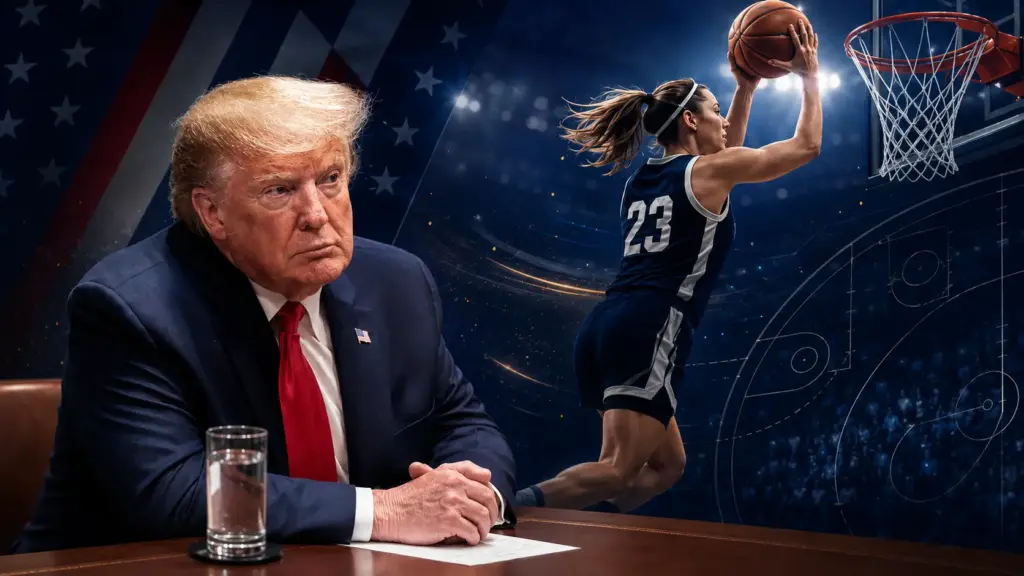
On April 3, 2026, the President of the United States signed the most ambitious executive order ever issued on American college athletics. Titled “Urgent National Action to Save College Sports,” the measure arrives after years of institutional chaos within the NCAA and aims to rewrite some of the rules that most directly affect any player who wants to study and compete at an American university. If you are considering taking that step, you need to understand what is happening.
The Transfer Portal Had Become a Free Market
To understand why Trump has intervened, you need to know what led up to this order. Since 2021, the NCAA allowed its athletes to transfer from university to university with full immediate eligibility, as many times as they wanted. The result was an uncontrolled market. In the 2026 women’s Transfer Portal cycle alone, more than 1,000 players entered it in less than two weeks. Entire programs were dismantled from one season to the next: Iowa State, for example, lost nine players — including several starters — after being eliminated in the first round of the NCAA Tournament. What was supposed to be a tool for academic mobility became a transfer market where money called the shots.
The American government itself described the situation as an “out-of-control financial arms race” that threatened to drain resources from every college sport except football and men’s basketball.
The Three Key Measures of the Executive Order
The order is set to take effect on August 1, 2026, and applies to universities with more than $20 million in annual athletics revenue. Its most relevant points for any player are three:
One free transfer as an undergraduate student. Under the new rules, you will be entitled to one penalty-free transfer during your undergraduate years. A second transfer with full immediate eligibility would only be possible if you have already completed a four-year degree. Any additional move would mean sitting out a season. This represents a radical shift from the current system, where transferring every year was perfectly legal.
A maximum eligibility window of five years. The order establishes a five-year participation window with no exceptions other than military service or recognized public interest absences. This closes the door on cases where players with five, six, or more years in the college system were taking the NCAA to court to secure additional seasons of eligibility — a practice that had completely distorted the age structure of many rosters.
Regulation of NIL agreements. The order defines as a “fraudulent NIL scheme” any arrangement that pays a player above fair market value as a concealed recruiting tool. Universities that fail to comply with these rules risk losing their federal grants and contracts.
What Is Still Unclear
It would be irresponsible to present this order as a done deal. The reality is more complex. Several American courts have already blocked similar measures from the same administration in the past, and the single-transfer restriction was itself ruled illegal by those same courts not long ago. General managers from some of the leading university conferences, when consulted by specialist media, were openly skeptical. What does seem clear is that the order has a second purpose: to pressure Congress into passing stable legislation that would grant the NCAA an antitrust exemption and establish lasting rules. Until that happens, the landscape will remain uncertain.
Why This Affects You Directly
If you are a Spanish player considering the American university route, this context matters for one concrete reason: the system is in the middle of a full revision, and navigating it alone without guidance is more risky than ever.
When the Transfer Portal operates without limits, top-level universities are constantly looking for proven, already-developed players to fill immediate needs. The result is that the space for developing young international talent from scratch shrinks. No program is going to take a chance on a freshman with no track record in the American system when they can sign a junior with three years of NCAA experience at zero cost.
This reinforces something Sport Change Project has defended from the beginning: the smart route for the majority of Spanish players is not to arrive directly in Division I and hope for playing time. It is to enter through a Junior College, prove your level over one or two years in a competitive but manageable environment, and then access the transfer market with real credentials on the table. If the new rules limit portal movement, your first university choice becomes even more strategic. And if nothing changes and the chaos continues, you will need exactly the same thing: to enter the system with an advantage.
The Key Does Not Change
Regardless of what happens on August 1, what is permanent is the complexity of the American college sports system. Rules change, courts contradict each other, and program budgets fluctuate. What does not change is that the players who arrive best supported are the ones who end up playing. Those who arrive alone at the airport with an acceptance letter and nobody who knows the terrain are the ones who disappear from the radar.
Trump’s executive order is, at its core, the official recognition of something we already knew: American college athletics urgently needs more structure. While that structure takes shape, the best protection you have is the right information and the right people by your side.